

Introduction:
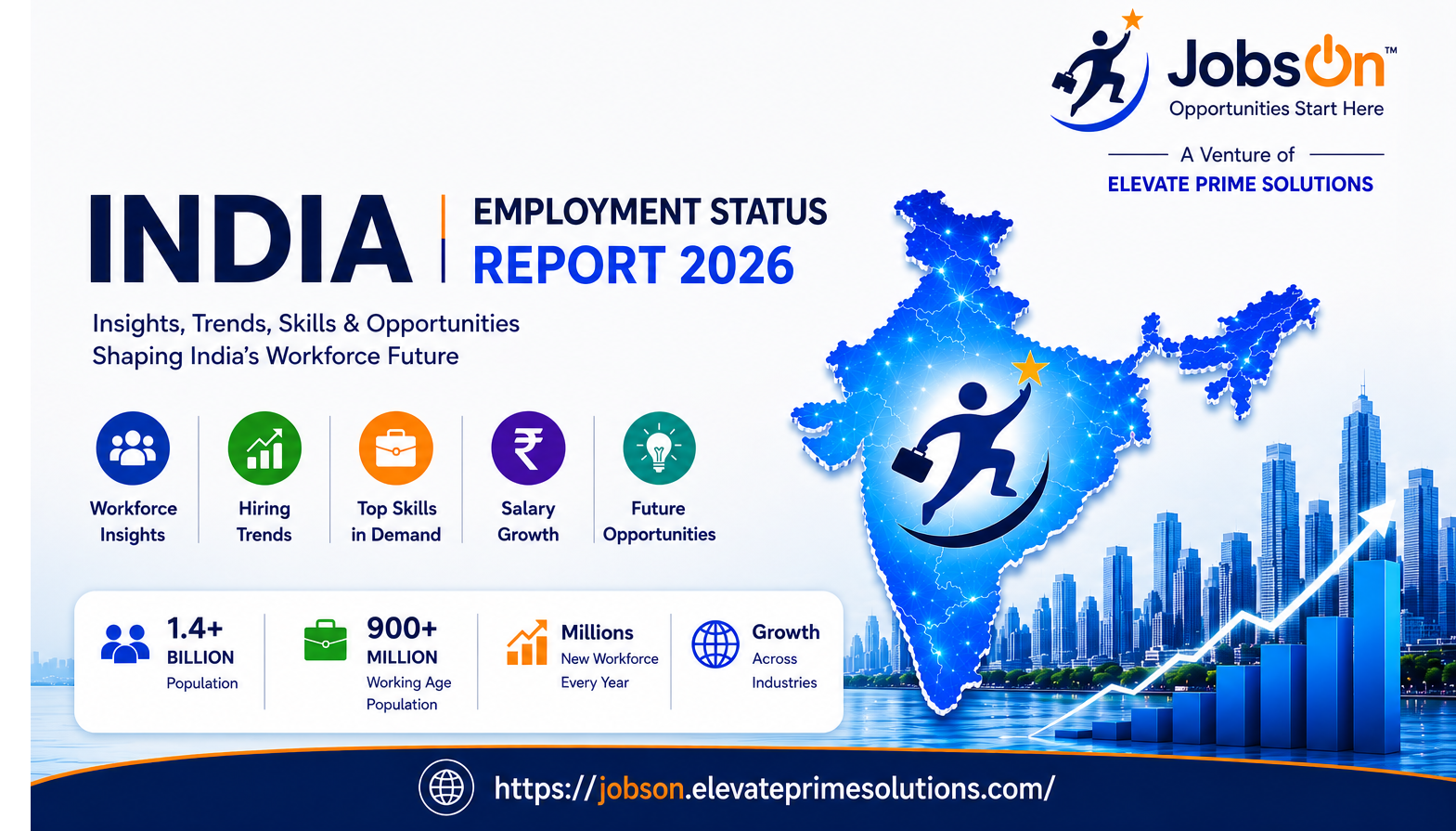
The India Employment Status Report 2026 provides a comprehensive overview of India’s changing employment landscape, hiring trends, workforce statistics, salary growth, skills in demand and future career opportunities. The India Employment Status Report 2026 highlights how businesses, industries and job seekers are adapting to a rapidly evolving employment market driven by technology, digital transformation and economic growth across PAN India.
India is home to more than 1.4 billion people and has one of the world’s largest working-age populations. Every year, millions of students graduate and enter the job market while thousands of companies expand their operations across industries such as Information Technology, Healthcare, Manufacturing, Banking, Retail, Logistics and Digital Services.
The employment landscape is changing rapidly. Earlier, companies focused mainly on filling vacancies. Today, organisations are looking for professionals with practical skills, digital knowledge, communication abilities and problem-solving capabilities. Likewise, candidates are seeking stable careers, competitive salaries, flexible work environments and long-term growth opportunities.
As digital recruitment continues to grow, platforms such as JobsOn are helping employers connect with skilled professionals while making it easier for job seekers to discover opportunities across India.
India Employment Status Report 2026: Employment Overview
India has one of the youngest workforces in the world, making it one of the strongest contributors to global economic growth. The combination of demographic advantage, digital transformation and entrepreneurship has created new employment opportunities across almost every sector.
According to the Ministry of Labour & Employment and various industry reports, employment generation remains a key driver of India’s long-term economic development.
The country’s workforce is increasingly moving towards:
- Skill-based hiring
- AI-assisted recruitment
- Remote and hybrid employment
- Digital-first workplaces
- Industry-specific certifications
- Continuous learning and upskilling
These trends indicate that the future of employment will depend not only on educational qualifications but also on practical skills and adaptability.
India Workforce Snapshot 2026:
| Employment Indicator | Current Overview |
|---|---|
| Total Population | 1.4+ Billion |
| Working Age Population | 900+ Million |
| Population Below 35 Years | ~65% |
| Internet Users | 800+ Million |
| Smartphone Users | 700+ Million+ |
| MSME Enterprises | 6+ Crore |
| Recognised Startups | 100,000+ |
| New Workforce Every Year | Millions of Professionals |
India Employment Status Report 2026: Employment Growth Trends:
ndia’s employment market has shown significant resilience over the past few years. While the economy experienced disruption during earlier global challenges, businesses have adapted quickly through digital adoption, manufacturing expansion and increased investments in technology.
Today, employment growth is being supported by:
- Digital transformation
- Government infrastructure projects
- Manufacturing expansion
- Startup ecosystem growth
- MSME development
- Artificial Intelligence adoption
These developments are creating opportunities for both fresh graduates and experienced professionals.
Employment Growth Timeline:
| Year | Employment Trend | Primary Growth Driver |
|---|---|---|
| 2022 | Recovery Phase | Digital Transformation |
| 2023 | Expansion Phase | Startup Growth |
| 2024 | Strong Growth | Artificial Intelligence |
| 2025 | Rapid Expansion | Manufacturing |
| 2026 | Opportunity Phase | Skilled Workforce |
India Employment Opportunity Growth Index:
22 ████████████ 60%
2023 ██████████████ 70%
2024 ████████████████ 78%
2025 █████████████████ 85%
2026 ████████████████████ 90%
India Employment Status Report 2026: Key Drivers of Employment Growth:
Several factors are contributing to the growth of employment opportunities across India.
1. Digital Transformation:
Businesses across every industry are investing in digital technologies such as:
2. Startup Ecosystem:
India has become one of the world’s leading startup ecosystems.
Supported by the Startup India initiative, startups are creating employment in:
- Technology
- Product Management
- Sales
- Marketing
- Finance
- Human Resources
- Customer Success
- Operations
Thousands of new businesses are contributing to job creation every year.
3. MSME Sector
Micro, Small and Medium Enterprises (MSMEs) continue to be one of the largest employment generators in India.
These businesses create opportunities in:
- Manufacturing
- Retail
- Services
- Logistics
- Export
- Local commerce
The MSME sector also plays a vital role in creating employment opportunities in Tier-2 and Tier-3 cities.
India Employment Status Report 2026: Industry-Wise Hiring Analysis:
Different industries are contributing to India’s employment growth at different rates. While technology continues to lead hiring, sectors such as healthcare, banking, manufacturing, education and logistics are also creating substantial opportunities.
Top Hiring Industries:
| Industry | Hiring Demand | Major Job Roles |
|---|---|---|
| Information Technology | Very High | Developers, AI Specialists, Data Analysts |
| Healthcare | Very High | Medical Staff, Pharma, Operations |
| Banking & Finance | High | Sales, Relationship Managers |
| Manufacturing | High | Engineers, Production Staff |
| Retail & E-commerce | High | Sales, Customer Support |
| Education | Growing | Trainers, Tutors |
| Marketing | High | SEO, Digital Marketing |
| Logistics | Growing | Supply Chain Professionals |
1. Information Technology Sector: Creating Digital Careers:
Technology continues to be one of India’s strongest employment generators.
Companies are hiring professionals because businesses are becoming increasingly digital.
High Demand Technology Roles:
| Industry | Hiring Demand | Major Roles |
|---|---|---|
| Information Technology | Very High | Developers, AI Engineers, Data Analysts |
| Healthcare | Very High | Medical Staff, Hospital Operations |
| Banking & Finance | High | Relationship Managers, Finance Executives |
| Manufacturing | High | Engineers, Production Managers |
| Retail & E-commerce | High | Sales, Customer Support |
| Education | Growing | Trainers, Faculty, Counsellors |
| Marketing | High | SEO, Performance Marketing |
| Logistics | Growing | Supply Chain & Operations |
Why Technology Hiring Will Continue Growing:
Technology is no longer limited to IT companies.
Today:
- Banks need technology
- Hospitals need technology
- Manufacturing companies need technology
- Retail businesses need technology
- Education platforms need technology
This means technology skills are becoming valuable across almost every industry.
2. Healthcare Sector Employment Growth:
Healthcare is becoming one of India’s fastest-growing employment sectors.
The demand is increasing due to:
- Expansion of hospitals
- Growth in healthcare services
- Increasing health awareness
- Pharmaceutical development
Healthcare Hiring Report:
| Job Role | Demand Level |
|---|---|
| Medical Representative | High |
| Healthcare Executive | High |
| Nurses | High |
| Hospital Operations | Growing |
| Pharma Sales Professional | High |
| Healthcare Manager | Growing |
Healthcare opportunities are also expanding beyond major cities, creating employment options across India.
3. Sales and Business Development Employment:
Sales continues to be one of the largest employment categories.
Every growing business requires professionals who can:
- Acquire customers
- Build relationships
- Increase revenue
- Expand markets
Sales Hiring Report
| Position | Hiring Industries |
|---|---|
| Sales Executive | Banking, Retail, Healthcare |
| Business Development Executive | Technology, Services |
| Relationship Manager | Finance, Insurance |
| Customer Success Executive | SaaS, Digital Companies |
PAN India State-Wise Employment Opportunity Report 2026:
India’s employment opportunities are no longer limited to metro cities. With digital transformation, infrastructure development, startup growth, and remote work adoption, companies are hiring talent from Tier-2 and Tier-3 cities as well.
Different states have developed their own employment strengths based on industries, infrastructure, and business ecosystems.
State-Wise Hiring Opportunities:
| State | Major Employment Industries | High Demand Roles |
|---|---|---|
| Maharashtra | IT, Finance, Manufacturing, Banking, Media | Software Developers, Sales Professionals, Finance Executives |
| Karnataka | IT, Startups, Technology Services | Developers, Data Analysts, Product Professionals |
| Delhi NCR | Corporate, Consulting, Finance, Sales | Business Development, Operations, Management Roles |
| Gujarat | Manufacturing, Export, Engineering | Engineers, Production, Quality Professionals |
| Rajasthan | Education, Tourism, Healthcare, Services | Teachers, Sales Executives, Healthcare Staff |
| Tamil Nadu | Automobile, Manufacturing, IT | Engineers, Technology Professionals |
| Telangana | IT, Pharma, Healthcare | Software Professionals, Pharma Experts |
| Uttar Pradesh | Manufacturing, Retail, Services | Sales, Operations, Production Staff |
| Kerala | Healthcare, Education, Services | Healthcare Professionals, Trainers |
| West Bengal | IT, Services, Manufacturing | Technology and Service Professionals |
| Madhya Pradesh | Manufacturing, IT Services, Education | Operations, Sales, Technical Roles |
City-Wise Employment Growth Report:
Major cities continue to attract companies because of infrastructure, talent availability and business ecosystems.
| City | Key Hiring Sectors | Popular Job Categories |
|---|---|---|
| Bengaluru | IT, Startups, AI | Developers, Engineers, Product Roles |
| Mumbai | Finance, Banking, Sales | Finance Professionals, Sales Executives |
| Delhi NCR | Corporate, Consulting, Technology | Business Development, Management |
| Hyderabad | IT, Pharma | Software, Healthcare Roles |
| Pune | IT, Automobile, Manufacturing | Engineers, Technology Professionals |
| Chennai | Automobile, IT, Manufacturing | Technical and Operations Roles |
| Ahmedabad | Manufacturing, Business Services | Engineers, Sales Professionals |
| Jaipur | Education, Tourism, IT Services | Trainers, Marketing, Sales |
| Indore | IT, Startups, Services | Digital Marketing, Operations |
| Chandigarh | IT Services, Education | Support and Technology Roles |
Salary Growth Report India 2026
Salary trends in India are changing because companies are focusing more on skills and performance.
Professionals with strong practical knowledge, communication ability, and technology awareness are receiving better opportunities.
Average Salary Trend by Career Category:
| Career Category | Entry-Level Salary Range | Experienced Professional Range |
|---|---|---|
| Software Development | ₹3 LPA – ₹8 LPA | ₹10 LPA – ₹30+ LPA |
| Artificial Intelligence | ₹5 LPA – ₹12 LPA | ₹15 LPA – ₹40+ LPA |
| Data Analytics | ₹4 LPA – ₹10 LPA | ₹12 LPA – ₹25+ LPA |
| Digital Marketing | ₹2.5 LPA – ₹7 LPA | ₹8 LPA – ₹20 LPA |
| Sales & Business Development | ₹2.5 LPA – ₹7 LPA | ₹10 LPA – ₹25 LPA |
| Healthcare | ₹2.5 LPA – ₹8 LPA | ₹10 LPA – ₹20 LPA |
| Finance | ₹3 LPA – ₹8 LPA | ₹12 LPA – ₹30 LPA |
| Human Resources | ₹3 LPA – ₹7 LPA | ₹10 LPA – ₹20 LPA |
Note: Salaries vary depending on experience, location, company size, industry, and individual skills.
Skill Demand Report India 2026:
The future employment market will be driven by skills.
Companies are moving from traditional hiring methods toward competency-based recruitment.
A candidate’s ability to perform is becoming more important than only academic qualifications.
Top Skills Companies Are Hiring For:
| Skill | Demand Level | Industry Usage |
|---|---|---|
| Artificial Intelligence | Very High | Automation, Data, Business Solutions |
| Communication Skills | Very High | Sales, Management, Customer Relations |
| Data Analytics | High | Business Decision Making |
| Digital Marketing | High | Online Growth |
| Sales Skills | Very High | Revenue Generation |
| Cloud Technology | High | Digital Infrastructure |
| Cybersecurity | Growing | Data Protection |
| Project Management | Growing | Business Operations |
| Problem Solving | Very High | Every Industry |
The Skill Gap Challenge in India:
India has a large workforce, but many businesses still face difficulty finding candidates with the required skills.
Employer Challenges:
| Challenge | Business Impact |
|---|---|
| Lack of practical knowledge | More employee training required |
| Communication issues | Interview rejection |
| Wrong candidate matching | Increased hiring cost |
| Limited industry exposure | Lower productivity |
| Skill mismatch | Longer recruitment cycle |
Candidate Challenges:
| Candidate Problem | Possible Solution |
|---|---|
| Lack of experience | Internships and practical projects |
| Resume not visible | Professional online profile |
| Difficulty finding jobs | Trusted job platforms |
| Skill gap | Continuous learning |
| Interview preparation | Career guidance |
Artificial Intelligence and Future of Employment:
Artificial Intelligence is one of the biggest factors influencing the future workplace.
AI is changing how companies:
- Recruit employees
- Analyse data
- Manage customers
- Automate operations
- Improve productivity
According to workforce development initiatives promoted by organisations like the National Skill Development Corporation, future employment will require professionals to continuously upgrade their skills.
AI Impact Across Industries:
| Industry | AI Application |
|---|---|
| Recruitment | Candidate matching and screening |
| Healthcare | Medical analysis support |
| Finance | Risk analysis and automation |
| Marketing | Campaign optimisation |
| Education | Personalised learning |
| Customer Service | AI assistants |
| Manufacturing | Smart automation |
Future Jobs Created by Artificial Intelligence:
AI will not only automate tasks but also create new career opportunities.
Emerging Roles:
- AI Specialists
- Prompt Engineers
- Automation Consultants
- Data Scientists
- AI Product Managers
- Machine Learning Engineers
- AI Business Analysts
Professionals who combine industry knowledge with AI tools will have a competitive advantage.
Remote and Hybrid Employment Trends:
The workplace model has permanently changed.
Companies are adopting flexible working structures because they provide:
- Better employee satisfaction
- Wider talent access
- Reduced operational costs
- Increased productivity
Remote Job Opportunities:
| Industry | Remote Work Opportunity |
|---|---|
| IT & Software | Very High |
| Digital Marketing | High |
| Customer Support | High |
| Consulting | Growing |
| Education | Growing |
| Sales | Increasing |
| Design | High |
How JobsOn is Helping Build India’s Employment Ecosystem:
The employment gap exists because candidates and companies often struggle to find each other.
JobsOn focuses on solving this challenge by creating a digital bridge between talent and opportunities.
Candiates Discover Better Opportunities:
Through JobsOn Job Search Platform, candidates can explore opportunities based on:
- Location
- Skills
- Experience
- Career interests
Create Professional Profiles
Candidates can build their profiles through JobsOn Candidate Registration and improve their visibility among employers.
Access Career Growth Opportunities
Employment is not only about finding a job.
It is about building a career.
JobsOn focuses on helping professionals discover opportunities aligned with their skills and goals.
Benefits for Employers:
Businesses can use JobsOn to:
Find Relevant Talent:
Companies can connect with candidates based on:
- Skills
- Experience
- Location
- Industry requirements
Improve Hiring Efficiency:
Digital recruitment helps companies:
- Reduce hiring time
- Reach more candidates
- Improve candidate matching
Employers looking to hire can connect through JobsOn Employer Platform.
Why Digital Recruitment Platforms Are The Future:
Traditional hiring methods have limitations.
Traditional Hiring vs Digital Hiring
| Traditional Recruitment | Digital Recruitment |
|---|---|
| Limited candidate reach | PAN India access |
| Manual searching | Technology-based matching |
| Longer hiring process | Faster recruitment |
| Location limitations | Remote hiring possibilities |
| Higher recruitment cost | Better efficiency |
Government Employment and Skill Development Initiatives:
India’s employment growth is supported by multiple initiatives.
The National Career Service Portal provides employment-related services for candidates and employers.
Skill development programs supported by Skill India Initiative focus on improving workforce capabilities and preparing professionals for future industries.
Frequently Asked Questions (FAQ)
1. What is the employment outlook for India in 2026?
India’s employment outlook remains positive due to growth in technology, healthcare, manufacturing, services and digital businesses.
2. Which sectors will create more jobs in India?
Major employment-generating sectors include:
- IT
- Healthcare
- Sales
- Manufacturing
- Finance
- Digital Marketing
- Education
3. Which skills will be important for future careers?
Important skills include:
- AI knowledge
- Communication
- Digital skills
- Data analysis
- Sales ability
- Problem solving
4. How can candidates improve employment opportunities?
Candidates should:
- Build strong profiles
- Learn new skills
- Gain practical experience
- Apply through reliable employment platforms
5. How can companies hire better talent?
Companies should use digital recruitment platforms, improve employer branding and focus on skill-based hiring.
Conclusion: Building The Future Of Employment In India
India’s employment ecosystem is entering a new chapter.
The future will not only depend on the number of jobs created but also on how effectively companies and candidates connect.
Businesses need skilled professionals.
Candidates need better opportunities.
Technology provides the solution.
With digital recruitment, AI adoption and skill-based hiring, India can build a stronger and more inclusive employment ecosystem.
JobsOn is working towards creating a platform where:
Talent meets Opportunity.
Whether you are a candidate searching for your next career move or a company looking for the right professionals, JobsOn aims to simplify the employment journey.